



- June 25, 2025
According to Gartner, 80% of data and analytics governance initiatives will fail by 2025 due to a lack of effective metadata management.
That’s a wake-up call. Data lineage, the ability to trace data from its origin to its end use has become non-negotiable in a world where businesses depend on data for every decision.
Without proper lineage, organizations are flying blind, risking compliance breaches, inaccurate reports, and poor strategic calls. But what if AI could illuminate every step your data takes, in real time?
Enter AI-powered data lineage!!
As organizations scale, automated data lineage solutions become essential for enterprise data lineage, ensuring every transformation is visible, trustworthy, and AI-ready.
What Is Data Lineage? And Why AI-Powered Data Lineage Is Essential Today
Essentially, data lineage talks about the life journey of data from the source till its destination. This encompasses how data traverses among systems, transformations it goes through, and finally, where it ends up. This is no longer a nice-to-have in today’s regulatory-heavy climate.
Effective data lineage is critical for:
Compliance with standards like GDPR, HIPAA, and SOX.
Data transparently trusted.
Root cause analysis speeded up in conducting outages/errors.
Organizations will end up having data mistrust and failed audits, therefore missing insights.
Can’t govern what can’t be seen pretty much tells the story.
With rising data complexity, end-to-end automated lineage now anchors modern data lineage implementation, delivering automated data lineage and the critical benefits required for accuracy and compliance.
The Rise of Automated Data Lineage: How Automation Changes Everything
Data volumes are exploding. Over 90% of today’s enterprise data has been created in the last two years, and with it comes a surge in complexity, pipelines, and compliance needs.
Yet most organizations still rely on manual lineage methods that are slow, error-prone, and nearly impossible to scale. That’s exactly where automated data lineage is reshaping the game.
Automated data lineage tools use AI, metadata intelligence, and pattern recognition to map data flow end-to-end, in minutes instead of weeks.
Companies adopting automation report up to 60% reduction in audit preparation time, 40% faster troubleshooting, and 70% higher accuracy in lineage documentation.
The result? Teams finally understand where data came from, how it transformed, and who touched it, without endless detective work.
Beyond efficiency, automation unlocks deeper business impact. It strengthens data trust, accelerates analytics, and compresses project timelines.
With regulations growing 15% year-over-year, automated lineage ensures organizations stay compliant without burning hundreds of hours on manual mapping. It also fuels better governance, 53% of data leaders say automation is now essential to meeting governance goals.
Enterprises that embrace automation aren’t just improving documentation, they’re building a smarter, more transparent, and future-proof data ecosystem.
The Real Costs of Poor Data Lineage: Risks, Failures & Compliance Gaps
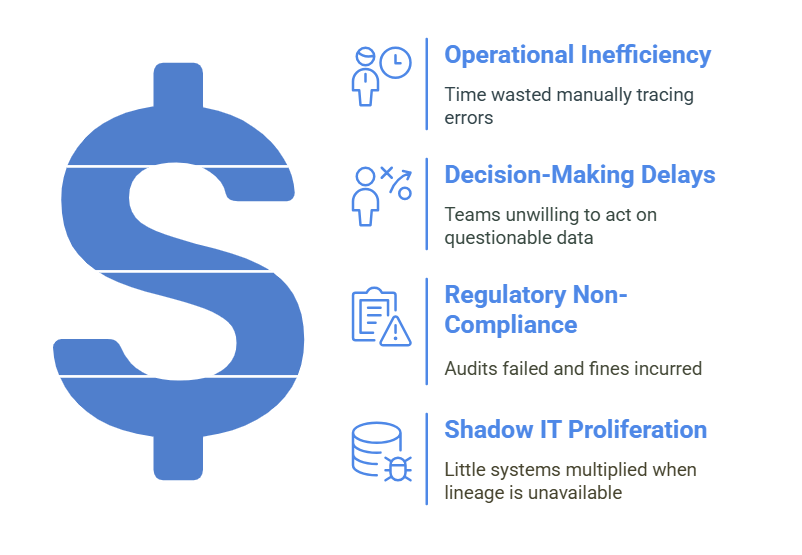
Don’t ever, ever say, “We’ll deal with data lineage challenges later.”
Consider the price:
Operational inefficiency: Time wasted manually tracing errors.
Longer lead times when making decisions: Teams are unwilling to act on questionable data.
Audits failed and fines incurred: Particularly regarding GDPR, HIPAA, and SOX.
Shadow IT: Little systems multiplied when lineage is unavailable.
These are not theoretical problems.
According to IDC, businesses lose an average of $ 15 million yearly as a result of poor quality and visibility of data.
As these data lineage challenges intensify, organizations are turning to enterprise data lineage to gain reliable oversight and ensure their data lineage can support AI governance with confidence and compliance.
Why Traditional Data Lineage Fails: Limitations in Modern, Hybrid, and Multi-Cloud Environments
Old approaches to data lineage are based on extensive manual mapping and utilizing outdated spreadsheets and static documentation. All the following:
1. No real-time tracking;
2. Have challenges with modern data stacks and unstructured sources;
3. Harness high maintenance;
4. Unable to scale in hybrid or multi-cloud environments.
5. And frankly, nobody has time to update those diagrams.
These manual data lineage limitations become harder to manage in hybrid cloud data lineage challenges, making automated data lineage solutions and tools with hybrid multi-cloud support essential.
AI vs Manual Data Lineage: A Clear Comparison
67% of enterprises still struggle to track how data moves across systems. Traditional, spreadsheet-driven methods simply can’t match today’s data velocity highlighting the growing gap in manual vs automated data lineage.
Manual lineage requires teams to interview stakeholders, map pipelines, and update diagrams every time a system changes, a process that can take 3–6 weeks per application. Even then, accuracy is questionable, with studies showing manual lineage contains up to 35% undocumented transformations.
With AI-powered data lineage, this entire process transforms. AI continuously scans metadata, queries, logs, and ETL flows to build lineage automatically in real time, dramatically accelerating data lineage automation and improving accuracy.
The difference becomes even more obvious during audits or incidents. Manual lineage often leads to last-minute scramble, AI lineage gives teams instant visibility, cutting root-cause analysis time by up to 60% and audit preparation efforts by 50–65%.
Most importantly, AI-driven lineage delivers deeper visibility, column-level tracing, impact analysis, and anomaly detection, bringing enterprise data lineage to a level manual method simply can’t reach.
AI-Powered Data Lineage: How Machine Learning Automates End-to-End Lineage
AI-powered data lineage automates the whole mapping process while providing real-time visibility into how data moves across your systems. It does that by:
1. Automatically discover metadata across platforms.
2. Using machine learning to infer relationships even when it comes to unstructured data.
3. Mapping dependencies, transformations, and impact paths.
4. Updating lineage views continuously in real-time.
This is the best practice in data lineage automation because it liberates teams from tedious exercises and enhances governance and transparency of data.
Key Benefits of AI-Powered Data Lineage for Governance, Compliance & Analytics
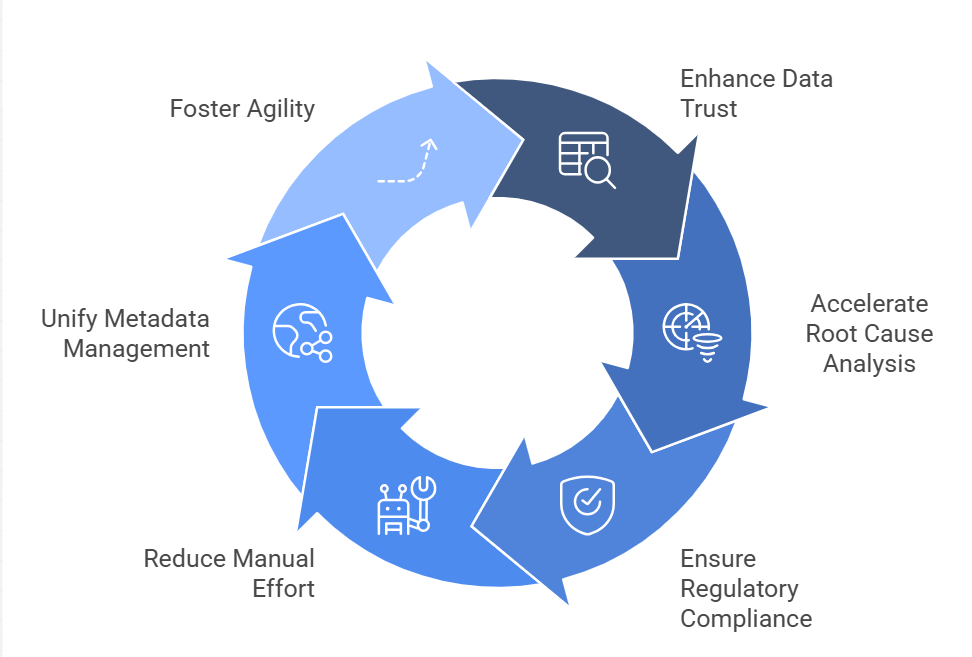
So why are more enterprises investing in AI-powered data lineage tools, right from compliance and analytics? Here are the keys:
Improved trust in data: Know where your data came from and what was done to it.
Faster root cause analysis: Identify problems in seconds.
Regulatory compliance: Confidently create defensible audit trails.
Reduced manual work: Let the AI do the grunt work.
Unified metadata management: See your whole data universe in one place.
Agility: Quickly act and be confident with agile data teams.
How AI Solves Data Lineage Challenges in Hybrid, Multi-Cloud & Cross-Application Environments
This is what a modern environment is, on-prem and hybrid and multi-cloud ecosystems. Traditional lineage tools aren’t cutting it as they should be. AI made possible:
1. Hybrid and multi-cloud support
2. Integration with other modern tools such as Snowflake, Databricks, Power BI, and many more.
3. Scalability over millions of data points
For instance, AI scans logs, ETL pipelines, and code to derive lineage even when the source documentation is missing. That’s real-time visibility into your data flows with AI.
Real-World Use Cases: Industry Applications of AI-Powered Data Lineage
Finance: 40% less time is spent getting ready for audits, with the help of AI lineage in tracking data used for regulatory reporting.
Healthcare: Tracing the information in the patient data access and transformations, compliance with HIPAA.
Manufacturing: Knowing the actual root causes of quality issues through data flow mapping.
Energy: Improved analysis of smart meters and consumption trends.
As Decube mentions, organizations implementing AI for lineage resolving issues at 60% faster turnaround time and with a 70% improved data transparency.
Choosing the Right AI-Powered Data Lineage Tools
There is no best tool to use. When evaluating, seek for the following criteria:
1. Auto-discovery and mapping
2. Pre-built integrations with your data stack
3. Impact analysis and reporting dashboards
4. Role-based access and data masking
Top tools to explore: Informatica, Atlan, Decube, Secoda, SAS Viya.
Checklist for Implementing AI-Powered Data Lineage
1. Getting Started: An Action Plan for Data Leaders
2. Do not try to boil the whole ocean at once. Here is how to start:
3. Audit your current data flows
4. Identify critical systems and high-risk areas
5. Start small with tools that automate
6. Align IT, governance, and BI teams
7. Track the progress of lineage maturity and revise regularly
8. Most platforms provide free trials or demos if you want to help.
Conclusion: From Blind Spots to Clarity with AI-Powered Data Lineage
AI-powered data lineage is no longer optional. This is the backbone of trust, compliance, and intelligent decision-making. Today’s complexity cannot be matched by manual approaches. Such lineage not only automates the process but also transforms how one sees and manages data in intelligent terms.
Start small. Automate smart. Believe in your data again!
FAQ:
What is data lineage and why is it so important?
Data lineage refers to the ability to track and visualize the journey of data as it moves through various systems, transformations, and processes. It’s essential for data transparency, building trust, supporting compliance, and ensuring accurate business intelligence across the organization.
What are the risks of not having data lineage?
Without effective lineage, organizations face operational inefficiencies, compliance risks, failed audits, and poor decision-making. It becomes difficult to trace data errors, leading to wasted time and significant business disruption.
How does AI improve data lineage?
AI eliminates the need for manual mapping by automatically discovering and tracking data relationships across platforms. It uses machine learning to provide real-time updates, identify dependencies, and simplify metadata management enabling fast, reliable, and scalable data governance.
Which industries would benefit the most from such AI-backed data lineage?
Industries like finance, healthcare, manufacturing, and energy all of which handle sensitive, complex, or regulated data benefit greatly from AI-powered lineage tools due to their ability to improve accuracy, audit-readiness, and risk management.
What is the difference between manual and automated data lineage?
Manual approaches involve static documentation that quickly becomes outdated. In contrast, AI-powered data lineage automation delivers dynamic, real-time insights, supports modern data architectures, and reduces operational overhead.
Can AI-powered data lineage help in terms of regulatory compliance?
Absolutely. These solutions create defensible audit trails and ensure traceability, which is crucial for meeting standards like GDPR, HIPAA, SOX, and others. Compliance teams can generate reports faster and with more accuracy.
How do I get started with AI-powered data lineage?
Begin with a clear audit of your current data flows, identify high-risk systems, and gradually introduce tools that offer automated lineage tracking. Collaboration among IT, governance, and analytics teams is key to long-term success.
What are the best AI-powered data lineage tools available?
Some of the top tools include Informatica, Atlan, Secoda, Decube, and SAS Viya each offering different strengths such as metadata discovery, integration support, compliance reporting, and real-time data flow tracking.